Situation Overview
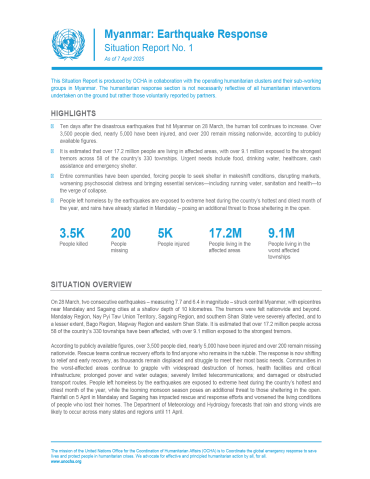
On 28 March, two consecutive earthquakes – measuring 7.7 and 6.4 in magnitude – struck central Myanmar, with epicentres near Mandalay and Sagaing cities at a shallow depth of 10 kilometres. The tremors were felt nationwide and beyond. Mandalay Region, Nay Pyi Taw Union Territory, Sagaing Region, and southern Shan State were severely affected, and to a lesser extent, Bago Region, Magway Region, and eastern Shan State. It is estimated that over 17.2 million people across 58 of the country’s 330 townships have been affected, with over 9.1 million exposed to the strongest tremors.
According to publicly available figures, over 3,500 people died, nearly 5,000 have been injured, and over 200 remain missing nationwide. Rescue teams continue recovery efforts to find anyone who remains in the rubble. The response is now shifting to relief and early recovery, as thousands remain displaced and struggle to meet their most basic needs. Communities in the worst-affected areas continue to grapple with widespread destruction of homes, health facilities, and critical infrastructure; prolonged power and water outages; severely limited telecommunications; and damaged or obstructed transport routes. People left homeless by the earthquakes are exposed to extreme heat during the country’s hottest and driest month of the year, while the looming monsoon season poses an additional threat to those sheltering in the open. Rainfall on 5 April in Mandalay and Sagaing has impacted rescue and response efforts and worsened the living conditions of people who lost their homes. The Department of Meteorology and Hydrology forecasts that rain and strong winds are likely to occur across many states and regions until 11 April.